When Britain sailed 12,000 kilometres to retake the Falkland Islands in 1982, some of its most feared soldiers were not British at all — they were Nepali. The Gurkhas of the 1st Battalion, 7th Duke of Edinburgh’s Own Gurkha Rifles carried their khukuri to the South Atlantic, and their reputation alone helped bring the war to an end.
Quick facts
- Who: 1st Battalion, 7th Duke of Edinburgh’s Own Gurkha Rifles (1/7 GR) — Nepali soldiers of the British Army — plus Queen’s Gurkha Signals and Queen’s Gurkha Engineers.
- War: The Falklands War (Operation Corporate), April–June 1982, after Argentina invaded the islands on 2 April 1982.
- Journey: Sailed from Southampton on the QE2 on 12 May 1982; landed at San Carlos Bay on 1 June.
- Key role: Guarding prisoners at Goose Green and advancing on Mount William beside the Scots Guards.
- Nepal’s loss: Two Gurkhas died — Lance-Corporal Budhaprasad Limbu and Corporal Krishnakumar Rai.
Why were Nepali soldiers fighting for Britain?
For more than 200 years, Britain has recruited soldiers from the hills of Nepal into the Brigade of Gurkhas. Drawn from communities such as the Limbu, Rai, Gurung and Magar, Gurkhas are famous worldwide for their discipline, loyalty and the curved khukuri knife they carry. So when Argentina seized the Falkland Islands in April 1982 and Britain assembled a naval task force to take them back, the Gurkhas were part of the plan.
The UK-based Gurkha battalion at the time, the 1/7th Gurkha Rifles, was stationed at Church Crookham in England as part of 5 Infantry Brigade. Within weeks it was preparing for war on the other side of the planet.
The long voyage south on the QE2
On 12 May 1982, the 1/7th Gurkhas — together with four members of 541 Troop, Queen’s Gurkha Signals — boarded the famous ocean liner Queen Elizabeth 2 (QE2) at Southampton. During the 21-day voyage to the South Atlantic the soldiers kept training on deck, and even celebrated the battalion’s 80th birthday at sea.
They arrived at San Carlos Bay, on the north of East Falkland, on 1 June 1982. While ‘D’ Company stayed behind to defend the landing site, the rest of the battalion was flown forward by helicopter towards Goose Green, where they relieved 2 Para and took charge of roughly 500 Argentine prisoners.
The khukuri that captured an enemy patrol
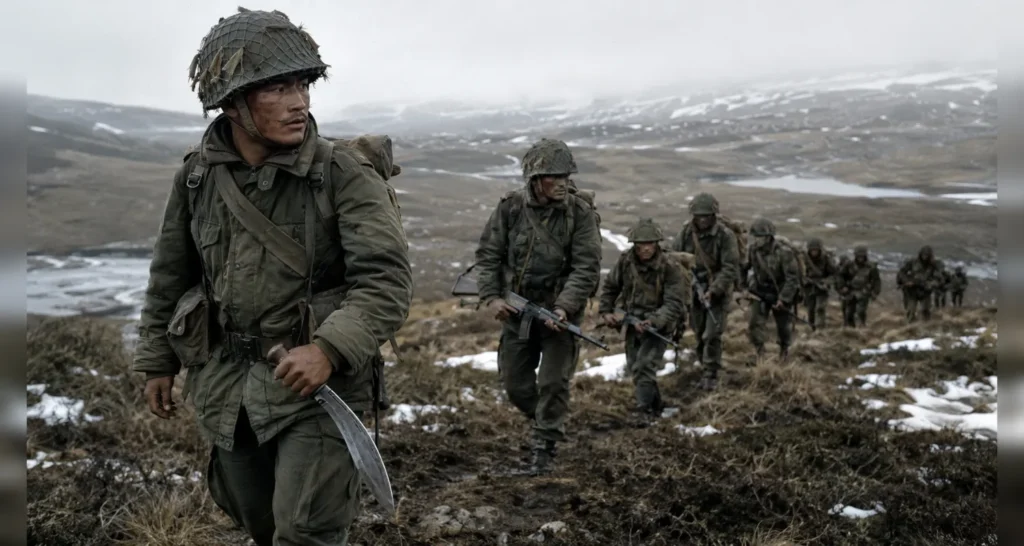
The Gurkhas then pushed out on aggressive patrols across Lafonia, the southern half of East Falkland. In one of the most remarkable moments of the campaign, a single Gurkha patrol captured a group of Argentine soldiers — commanded by an officer and armed with anti-aircraft weapons — simply by brandishing a khukuri in a threatening manner. No shots were needed. The reputation of the blade did the work.
Their toughness was just as striking. ‘D’ Company marched on foot from San Carlos to Goose Green in under 36 hours, some men carrying more than 140 pounds of equipment.
The advance on Mount William
By 9 June the battalion had moved east to Fitzroy. As part of a 5 Brigade attack towards Mount Tumbledown and Mount William, the Gurkhas were ordered to work alongside the Scots Guards, move along a ridge known as Goat Ridge, and take Mount William from the north — a night attack through ground that was almost certainly mined.
It was dangerous from the start. On 11 June, four men of ‘B’ Company were wounded by shrapnel from Argentine artillery. Delays pushed the assault into daylight on 14 June, and as the battalion advanced it came under artillery and mortar fire, taking eight more casualties, two of them serious. Yet for men under fire for the very first time, their calm was remarkable. As one company second-in-command, Captain (QGO) Bhuwansing Limbu, reportedly remarked to his commander mid-battle:
“Jolly exciting this, isn’t it?”
The fear factor: how reputation ended the fight
As ‘D’ Company pressed towards Mount William, something extraordinary happened. Large numbers of Argentine soldiers began surrendering to the nearby Scots Guards or withdrawing rapidly towards Port Stanley. Many historians believe the Gurkhas’ fearsome reputation caused outright panic once Argentine troops realised who they were about to face.
After the surrender, Argentine soldiers told reporters that rumours of Gurkhas slitting throats with a single khukuri stroke and leaping into foxholes had shattered their morale. Whether the rumours were true or not, the psychological effect was real — and on 14 June 1982, all Argentine forces on the Falklands surrendered, ending the war that same day.
The price Nepal paid
The Gurkhas came through the fighting with remarkably few losses, but they did not come through untouched. On 24 June, back near Goose Green, Lance-Corporal Budhaprasad Limbu was killed when his spade struck a live grenade as he cleared the old battlefield — the battalion’s only fatality. He was one of just two Gurkhas to die as a result of the war. The other, Corporal Krishnakumar Rai of the Queen’s Gurkha Engineers, was killed in an ordnance explosion during clean-up operations later in 1982.
The battalion stayed on to help the islanders return to normal life before sailing home on the SS Uganda, reaching Fleet in England on 9 August 1982 — just ninety days after they had left.
Why the Falklands still matters to Nepal
For Nepal, the Falklands War is one more chapter in a long, proud and complicated story of Gurkha service abroad. It shows how Nepali courage shaped events far from the Himalaya, and it feeds directly into modern debates that still matter today — from the long campaign for equal Gurkha pensions and settlement rights in Britain, to the pride Nepali families take in relatives who have worn the khukuri around the world. Every Falklands veteran who returned to a village in the hills carried a piece of world history home with him.
Frequently asked questions
Did Gurkhas fight in the Falklands War?
Yes. The 1st Battalion, 7th Duke of Edinburgh’s Own Gurkha Rifles — Nepali soldiers of the British Army — served in the 1982 Falklands War, supported by Queen’s Gurkha Signals and Queen’s Gurkha Engineers.
What did the Gurkhas do in the Falklands?
They landed at San Carlos, guarded around 500 Argentine prisoners at Goose Green, patrolled Lafonia, and advanced on Mount William alongside the Scots Guards. Their reputation is widely credited with helping trigger mass Argentine surrenders.
Were the Argentines afraid of the Gurkhas?
Reportedly, yes. Argentine soldiers later said rumours about the Gurkhas and their khukuri knives badly damaged their morale, and many surrendered or withdrew rather than face them.
How many Gurkhas died in the Falklands War?
Two: Lance-Corporal Budhaprasad Limbu, killed by a grenade while clearing a battlefield, and Corporal Krishnakumar Rai of the Queen’s Gurkha Engineers, killed in an ordnance explosion during clean-up operations.
What is a khukuri?
The khukuri (or kukri) is the traditional curved Nepali knife carried by Gurkha soldiers. It is both a working tool and a weapon, and it is a powerful symbol of Gurkha identity.
Sources: The Gurkha Museum, Winchester; National Army Museum; Battle of Mount Tumbledown (Wikipedia); CNN.