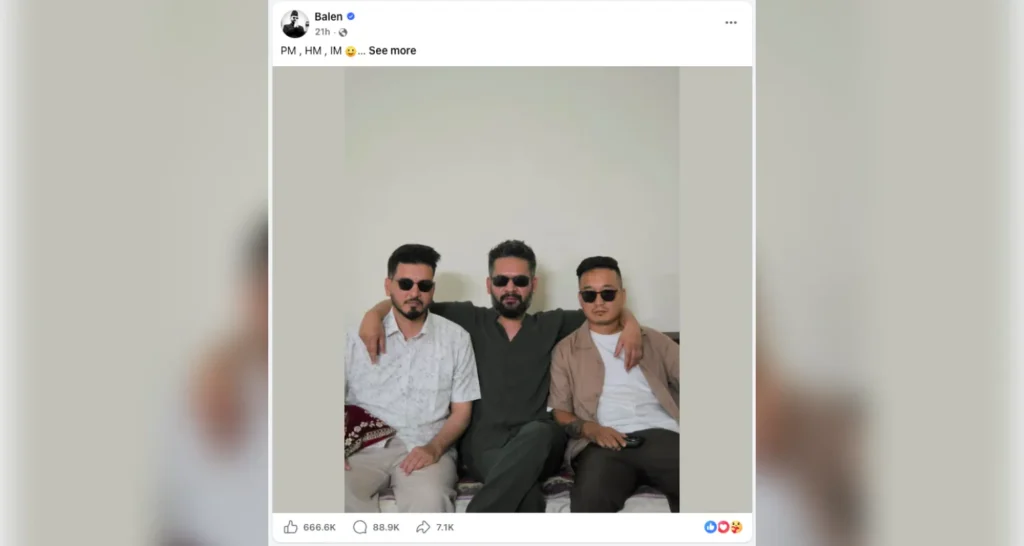
A single Facebook post from Prime Minister Balen Shah has set Nepali social media buzzing. In it, the PM shared a photo of three leaders labelled simply “PM, HM, IM” with the caption “Desh Banaune Toli” — the “Nation-Building Team.” Within hours, Nepalis were searching for what the abbreviations mean and, above all, who the “IM” of Nepal is. This article decodes the post, explains the titles, and introduces the man behind the IM tag — Sunil Lamsal, Nepal’s Minister of Infrastructure Development.
Tip: you can write these Nepali names — बालेन शाह, सुदन गुरुङ, सुनिल लम्साल — using our English to Nepali typing tool.
What do PM, HM and IM stand for?
The three abbreviations in Balen Shah’s “Desh Banaune Toli” post stand for the three ministers pictured:
- PM — Prime Minister: Balen Shah
- HM — Home Minister: Sudan Gurung
- IM — Infrastructure Minister: Sunil Lamsal
An important clarification: in this post, “IM” means Infrastructure Minister — the Minister for the Ministry of Infrastructure Development. It does not mean “Information Minister.” Communication and information technology is handled by a separate ministry in Nepal, so if you searched “information minister of Nepal” expecting this trio, the figure trending alongside the PM and HM is the Infrastructure Minister, Sunil Lamsal.
Who is the IM of Nepal? — Sunil Lamsal
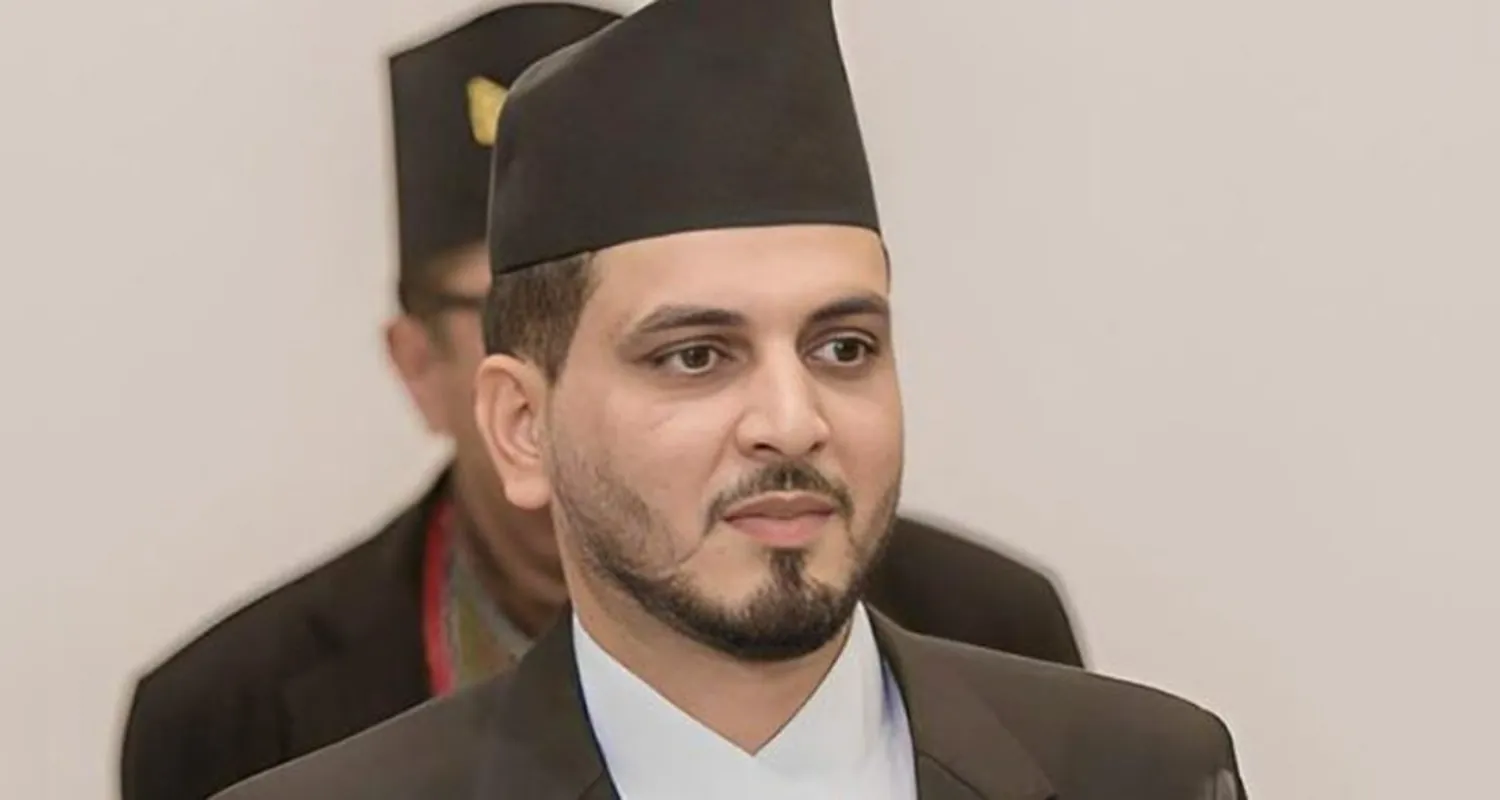
Sunil Lamsal is a Nepali politician and structural engineer who serves as the Minister of Infrastructure Development of Nepal. A member of the Rastriya Swatantra Party (RSP), he was elected to the House of Representatives from the Rupandehi-1 constituency in the 2026 general election and is one of the youngest members of Prime Minister Balen Shah’s cabinet.
Sunil Lamsal age and birthplace
Sunil Lamsal was born on 4 October 1990 in Kaligandaki Rural Municipality, Syangja District, Nepal, making him 35 years old in 2026. His family moved to Tilottama Municipality in Rupandehi in 1995, where he completed his schooling. He is the son of Bodhraj Lamsal and Jamuna Lamsal.
Sunil Lamsal education and qualification
Lamsal earned a Bachelor’s degree in Civil Engineering from Lumbini Engineering College, followed by a Master’s degree in Structural Engineering from the Nitte Meenakshi Institute of Technology (NITTE) in Bengaluru, India — the same institution where Prime Minister Balen Shah studied. He is currently pursuing a PhD in Solid Waste Management at Kathmandu University.
Career and infrastructure work
Before national politics, Lamsal worked as an infrastructure and environment expert at the Kathmandu Metropolitan City under Mayor Balen Shah, focusing on waste management, urban planning and traffic solutions. He has been associated with several major national projects, including work related to the reconstruction of Gautam Buddha International Airport in Bhairahawa, the development of Pokhara International Airport, and works at Singha Durbar, as well as model schools across 35 districts and hospitals in 12 districts. He began his political journey as a student leader (campus president through ANNFSU) before joining the RSP.
Election and ministry
In the 2026 general election, Lamsal won the Rupandehi-1 seat with 54,845 votes, a margin of more than 42,000 over his nearest rival. He first took office on 27 March 2026 as Minister of Physical Infrastructure and Transport and Minister of Urban Development. When those ministries were merged, he became the first Minister of Infrastructure Development, assuming the role on 14 May 2026.
The New Ministry of Infrastructure Development
The Ministry of Infrastructure Development (पूर्वाधार विकास मन्त्रालय) was established on 13 May 2026 as part of the Balen Shah government’s administrative overhaul that cut Nepal’s federal ministries to 18. It was formed by merging the former Ministry of Physical Infrastructure and Transport and the Ministry of Urban Development, and absorbing the water-infrastructure wing of the dissolved Ministry of Water Supply. Headquartered at Singha Durbar, the ministry is responsible for planning, building and overseeing Nepal’s large-scale physical assets — road networks, transport systems and urban facilities — making the “IM” one of the most powerful delivery-focused posts in the new government.
The Full “Desh Banaune Toli”: PM, HM and IM
Here is who makes up the trio in Balen Shah’s viral “Nation-Building Team” post:
PM — Balen Shah (Prime Minister)
Balendra “Balen” Shah is the rapper-turned-engineer-turned-politician who became the youngest elected Prime Minister of Nepal in March 2026 after the RSP’s landslide victory. Read the full Balen Shah biography »
HM — Sudan Gurung (Home Minister)
Sudan Gurung is the founder of Hami Nepal and a key leader of the 2025 Gen Z protests, who serves as Home Minister in the Balen Shah cabinet. Read the full Sudan Gurung biography »
IM — Sunil Lamsal (Infrastructure Minister)
Sunil Lamsal, the structural engineer profiled above, completes the trio as Minister of Infrastructure Development — the team member tasked with turning the government’s “nation-building” slogan into roads, transport and urban projects.
Why the Post Went Viral
The “Desh Banaune Toli” post struck a chord because all three figures represent the same story that brought this government to power: a young, technically-skilled, outsider generation taking charge after the 2025 Gen Z protests. Two of the three — the PM and the IM — are structural engineers, and the framing of a compact “team” built to deliver visible development resonated with supporters. As with much of Balen Shah’s social-media style, the post also drew debate, with critics urging the team to focus on results over branding. Either way, it sent searches for “IM of Nepal” and “infrastructure minister of Nepal” soaring.
IM vs Information Minister — Clearing Up the Confusion
Because “IM” can look like an abbreviation for “Information Minister,” many people searched that term after seeing the post. To be clear: in Balen Shah’s “Desh Banaune Toli,” IM stands for Infrastructure Minister (Sunil Lamsal). Information and communications is a separate portfolio in Nepal’s government, handled by the Ministry of Communication and Information Technology — a different ministry and minister altogether.
Sunil Lamsal — Quick Facts
| Full Name | Sunil Lamsal (सुनिल लम्साल) |
| Role | Minister of Infrastructure Development (“IM”) |
| Date of Birth | 4 October 1990 |
| Age (2026) | 35 years |
| Birthplace | Syangja District, Nepal (raised in Rupandehi) |
| Education | BE Civil Engineering (Lumbini Engineering College); MTech Structural Engineering (NITTE, India); PhD candidate (Kathmandu University) |
| Profession | Structural engineer, politician |
| Political Party | Rastriya Swatantra Party (RSP) |
| Constituency | Rupandehi-1 (MP, elected 2026) |
| In Office (IM) | Since 14 May 2026 |
Frequently Asked Questions (FAQ)
Who is the IM of Nepal?
The IM (Infrastructure Minister) of Nepal is Sunil Lamsal, a structural engineer and RSP Member of Parliament from Rupandehi-1, who serves as Minister of Infrastructure Development.
What does IM stand for in Balen Shah’s post?
In the “Desh Banaune Toli” post, IM stands for Infrastructure Minister — not Information Minister. It refers to Sunil Lamsal, the Minister of Infrastructure Development.
Who is the Infrastructure Minister of Nepal?
Sunil Lamsal is the Minister of Infrastructure Development of Nepal, having taken charge of the newly merged ministry on 14 May 2026.
Is the IM the same as the Information Minister of Nepal?
No. IM here means Infrastructure Minister. Information and communications is handled by the separate Ministry of Communication and Information Technology.
What is “Desh Banaune Toli”?
“Desh Banaune Toli” means “Nation-Building Team.” It is the caption Prime Minister Balen Shah used in a Facebook post featuring the PM (Balen Shah), HM (Sudan Gurung) and IM (Sunil Lamsal).
How old is Sunil Lamsal?
Sunil Lamsal is 35 years old, born on 4 October 1990 in Syangja, Nepal.