Driving in Nepal could soon get a lot more expensive if you break the rules. Traffic police have proposed raising fines for traffic violations from the current Rs 500–1,000 to as much as Rs 5,000–50,000, arguing that today’s penalties are far too small to stop the growing chaos on Nepal’s roads. The proposal — tied to the long-pending new Vehicle and Transport Management Bill — was presented to a parliamentary committee in mid-June 2026 and has quickly become one of the most debated topics among Nepali drivers.
Here is everything you need to know: the full list of proposed traffic fines, why the hike is being pushed, what officials actually said, and what it means for you as a rider or driver.
Full list of proposed traffic fines in Nepal
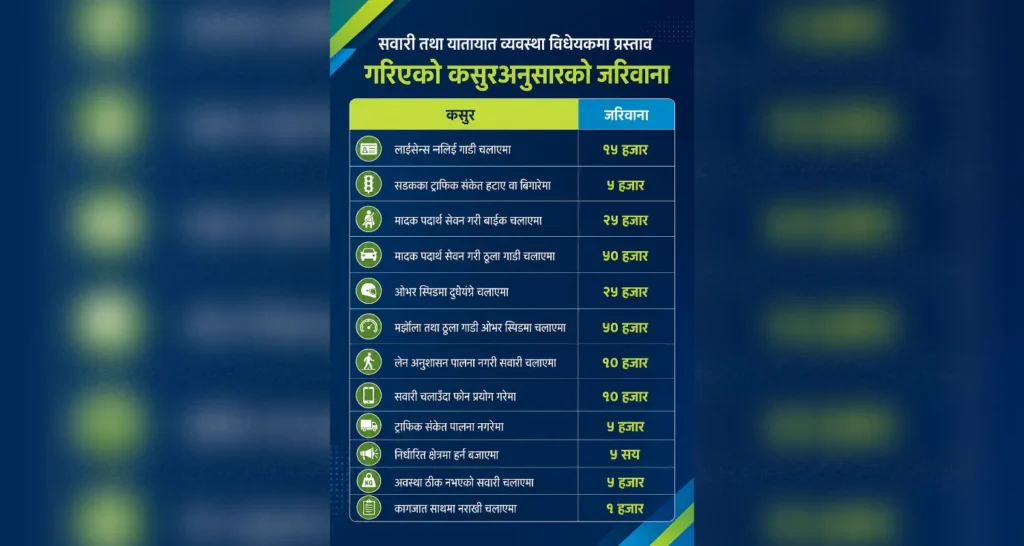
According to the proposed penalty structure under the Transport Management Bill, the new fines would be many times higher than what drivers pay today. Here is the proposed offence-wise penalty list:
| Offence (कसुर) | Proposed Fine (जरिवाना) |
|---|---|
| Driving without a licence | Rs 15,000 |
| Removing or damaging road traffic signs | Rs 5,000 |
| Drunk driving — motorbike / two-wheeler | Rs 25,000 |
| Drunk driving — large vehicle | Rs 50,000 |
| Over-speeding on a two-wheeler | Rs 25,000 |
| Over-speeding — medium & large vehicles | Rs 50,000 |
| Driving without lane discipline | Rs 10,000 |
| Using a mobile phone while driving | Rs 10,000 |
| Not obeying traffic signals / signs | Rs 5,000 |
| Honking in a no-horn (restricted) zone | Rs 500 |
| Driving a vehicle in unfit / poor condition | Rs 5,000 |
| Driving without documents (bluebook, licence) | Rs 1,000 |
Note: These figures are proposals presented during committee discussions on the new Transport Management Bill. They are not yet law. Final penalty amounts will be confirmed only after the bill is debated and passed by Parliament.
Why are traffic fines being increased?
The push for higher fines came from a meeting of the House of Representatives’ Infrastructure Development Committee on 16 June 2026. Senior Superintendent of Police (SSP) Suresh Prasad Kafle of the Kathmandu Valley Traffic Police Office briefed lawmakers on how badly stretched the system has become, and committee chairperson Ashish Gajurel argued that the existing fines of Rs 500 and Rs 1,000 “do not create sufficient deterrence.”
The numbers tell the story. Nepal now has roughly 6.5 million registered vehicles, and on an average day around 2 million vehicles operate inside the Kathmandu Valley alone. Managing all of them are just 2,500–2,600 traffic police personnel nationwide. With a handful of officers trying to discipline millions of vehicles, small fines simply do not change driver behaviour.
SSP Kafle warned that without urgent reform, Kathmandu Valley’s traffic could deteriorate so severely within two years that even basic movement on the roads may become difficult.
It’s not just about higher fines
Importantly, the proposal goes well beyond raising penalties. SSP Kafle recommended a package of modern reforms to fix traffic management at its root, including:
- AI-based integrated traffic systems and synchronised traffic lights across the Valley (estimated to cost Rs 15–20 billion).
- Mandatory dashboard cameras in both public and private vehicles to collect accurate accident evidence.
- Integrated digital border check posts and weighbridges to monitor cargo and stop overloaded vehicles.
- A scrappage policy to remove old and expired vehicles from the roads.
- Traffic education in school curricula to build road discipline from an early age.
- Expanded use of drones and robotic surveillance, plus tighter enforcement on overloaded Indian vehicles entering through border points.
The bigger picture: the new Transport Management Bill, 2081
These fines are part of a much larger reform — the Vehicle and Transport Management Bill, 2081, which is meant to replace the outdated Vehicle and Transport Management Act of 2049 (1993). The Ministry of Physical Infrastructure and Transport prepared the draft and forwarded it to the Cabinet in mid-2025, but it was returned after a change in government and has stayed pending for nearly a year.
Beyond fines, the broader draft law is reported to include provisions such as extending the validity of general driving licences to ten years, requiring medical certificates for licence renewal, stricter health and behavioural checks, and licence suspension for involvement in fatal accidents. Some versions of the draft even discuss on-the-spot penalties reaching up to Rs 100,000 for the most serious offences — which is why the bill matters to every single driver in the country.
Current fines vs proposed fines
To understand the scale of the change, compare a few common violations. Today, drunk driving typically attracts a fine in the range of Rs 1,000–1,500, lane indiscipline around Rs 1,000, and mobile phone use about Rs 3,000 (often with the licence held). Under the proposal, those same offences would jump to Rs 25,000–50,000 for drunk driving, Rs 10,000 for lane indiscipline, and Rs 10,000 for phone use. For most riders, that is the difference between a minor inconvenience and a fine worth several days’ or weeks’ income.
Demerit points still apply
Remember that fines are only one part of Nepal’s enforcement system. Traffic violations also add demerit points to your driving licence, and accumulating too many points within a year can lead to licence suspension. Combined with the proposed higher fines, repeat offenders would face both a heavy financial hit and the risk of losing the right to drive.
What it means for drivers and riders
If the bill passes in anything close to its proposed form, the cost of careless driving will rise sharply. The practical takeaway is simple: the habits that used to cost a few hundred rupees — riding after drinking, speeding, jumping lanes, or texting at the wheel — could soon cost tens of thousands. The cheapest way to deal with the new fines is to not earn them in the first place: always carry your licence and bluebook, wear a helmet, respect lane markings and speed limits, never drink and drive, and keep your phone down while driving.
Debate and criticism
The proposal has sparked a healthy debate. Supporters argue that Nepal’s roads have become dangerously undisciplined and that only meaningful penalties will change behaviour. Critics, however, point out that fining drivers heavily while roads remain poorly designed, signage is missing, and lane markings are faded is unfair — and that enforcement must go hand in hand with investment in better infrastructure, public transport and driver education. Lawmakers on the committee themselves stressed that reforms must move “simultaneously across legal, technical, and institutional fronts,” not through fines alone.
Frequently Asked Questions
Are these new traffic fines already in effect?
No. As of mid-2026 these are proposed fines being discussed in a parliamentary committee as part of the new Transport Management Bill. They become law only after Parliament debates and passes the bill.
What is the highest proposed traffic fine?
Under the offence list discussed, the highest proposed penalty is Rs 50,000 — for drunk driving of large vehicles and for over-speeding by medium and large vehicles. Wider versions of the draft law reportedly allow penalties up to Rs 100,000 for the most serious offences.
How much is the fine for using a phone while driving?
The proposal sets a Rs 10,000 fine for using a mobile phone while driving — a sharp increase from the current penalty of around Rs 3,000.
Why does Nepal want to raise traffic fines so much?
Officials say current fines of Rs 500–1,000 are too low to deter violations, especially with only about 2,500–2,600 traffic police managing 6.5 million vehicles nationwide. Higher fines are meant to improve compliance and road safety.
Will the new law change driving licence rules too?
Yes. Alongside higher fines, the new Transport Management Bill reportedly proposes extending licence validity to ten years, requiring medical certificates for renewal, and suspending licences for those involved in fatal accidents.
The bottom line
Nepal’s proposed traffic fines mark one of the biggest shifts in road enforcement in decades — from token penalties to fines that genuinely hurt. Whether or not the exact figures survive the parliamentary process, the direction is clear: stricter rules, smarter technology, and far less tolerance for reckless driving. The smartest move for every Nepali driver is to start treating road rules as seriously now as the law soon will.
Sources & further reading: Khabarhub — Proposal to hike traffic fines up to Rs 50,000, ShareSansar — Traffic Police proposes fines of up to Rs 50,000, MyRepublica — Drivers, Be Aware, and the Ministry of Physical Infrastructure and Transport (MoPIT).