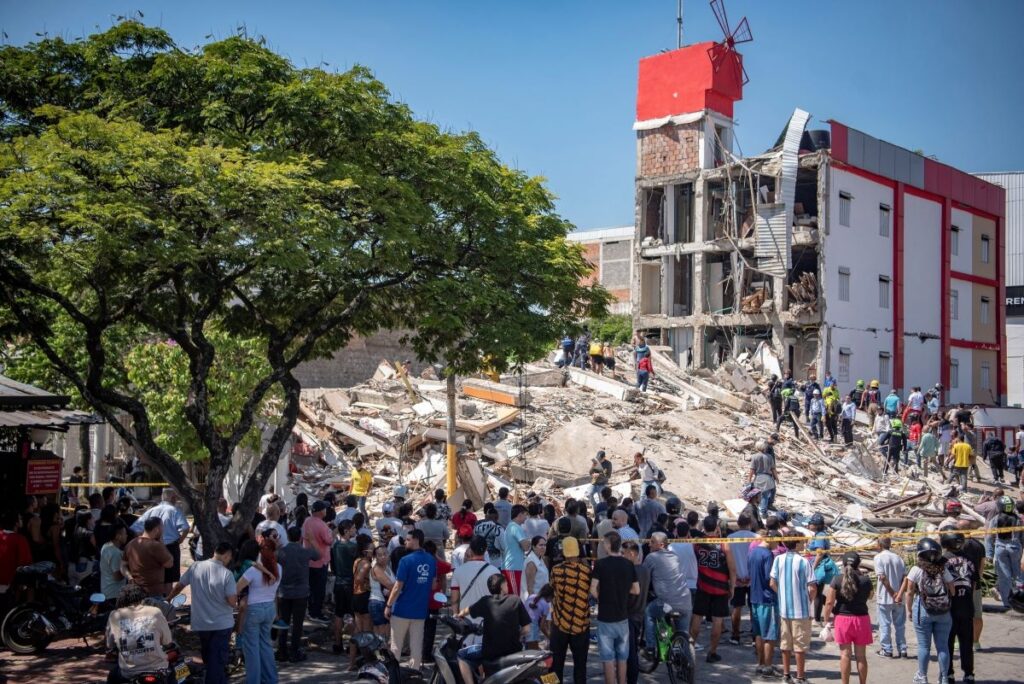
A powerful magnitude 7.4 earthquake struck western Colombia early on Monday, 10 August 2026, killing more than 130 people, injuring dozens and flattening buildings across the country’s coffee-growing heartland. The shaking was felt as far away as Bogotá, Medellín and neighbouring Ecuador and Panama, making it one of the strongest quakes in Colombia’s recorded history.
Colombia earthquake — key facts
| Magnitude | 7.4 (moment magnitude, USGS) |
|---|---|
| Date & time | Early Monday, 10 August 2026 |
| Epicentre | Near San José del Palmar, Chocó department, western Colombia |
| Depth | Deep — roughly 107–115 km |
| Distance from Bogotá | About 240 km (150 miles) west |
| Casualties | More than 130 dead and rising; dozens injured (developing) |
Where did the earthquake in Colombia hit?
According to the US Geological Survey (USGS), the epicentre was located near San José del Palmar in the Chocó department of northwestern Colombia, roughly 240 kilometres west of the capital, Bogotá. The quake was relatively deep, at around 107–115 kilometres, which allowed its energy to spread across a wide area — one reason it was felt in cities hundreds of kilometres from the epicentre.
The USGS estimated that around 10.5 million people experienced strong to very strong shaking (intensity VI–VII), across Colombia’s densely populated western and central regions.
Damage and death toll
The earthquake caused severe, widespread destruction across western and central Colombia. Multi-storey buildings collapsed in several cities, entire residential blocks were reduced to rubble, and one of the towers of a historic cathedral in Manizales was cracked apart. Authorities reported dozens of collapsed buildings and well over a thousand damaged homes.
The confirmed death toll has climbed through the day and is expected to rise further as rescuers reach hard-hit areas. Some of the worst-affected cities include:
- Cali — Colombia’s third-largest city, home to about 2.2 million people, among the hardest hit.
- Pereira — capital of Risaralda, which saw some of the most visible destruction.
- Quibdó, Manizales and Armenia — cities across the coffee region reporting damage and casualties.
The government declared a state of emergency, deploying the army, rescue teams and medical staff to the disaster zone.
Was the earthquake felt in Bogotá, Medellín and abroad?
Yes. Residents in Bogotá and Medellín reported strong, prolonged shaking that sent people running into the streets, even though those cities are far from the epicentre. The tremor was also felt in neighbouring Ecuador and Panama. Colombia sits on the seismically active boundary where the Nazca, South American and Caribbean tectonic plates meet, which makes the country prone to powerful earthquakes.
One of the strongest quakes in Colombia’s history
Officials say Monday’s 7.4 tremor is among the strongest to strike Colombia since national record-keeping began in the early 1920s. It is being compared to past disasters such as the deadly 1999 Armenia (Eje Cafetero) earthquake, which killed around 1,000 people in the same coffee-growing region.
How to stay safe during and after an earthquake
- During shaking: Drop, cover and hold on — get under sturdy furniture and away from windows.
- After the quake: Expect aftershocks; avoid damaged buildings and check for gas leaks.
- Stay informed: Follow official channels such as Colombia’s geological service (SGC) and local emergency authorities.
- Help responsibly: Donate through established, verified relief organisations rather than unverified appeals.
Frequently asked questions
How strong was the Colombia earthquake today?
It measured magnitude 7.4 on the moment magnitude scale, according to the USGS.
Where was the earthquake in Colombia?
The epicentre was near San José del Palmar in the Chocó department of western Colombia, about 240 km west of Bogotá, at a depth of around 107–115 km.
Was the earthquake felt in Bogotá?
Yes. Strong shaking was felt in Bogotá, Medellín, Cali and other cities, and even in neighbouring Ecuador and Panama.
How many people died in the Colombia earthquake?
More than 130 deaths had been confirmed as of this update, with the toll expected to rise. This is a developing story; check official sources for the latest figures.
Why do earthquakes happen in Colombia?
Colombia lies where the Nazca, South American and Caribbean tectonic plates meet, a highly active seismic zone that produces frequent and sometimes powerful earthquakes.
This is a developing, sensitive story and casualty figures are changing; please verify the latest numbers with official sources. Sources: USGS, CNN, Al Jazeera, CBS News, TIME.