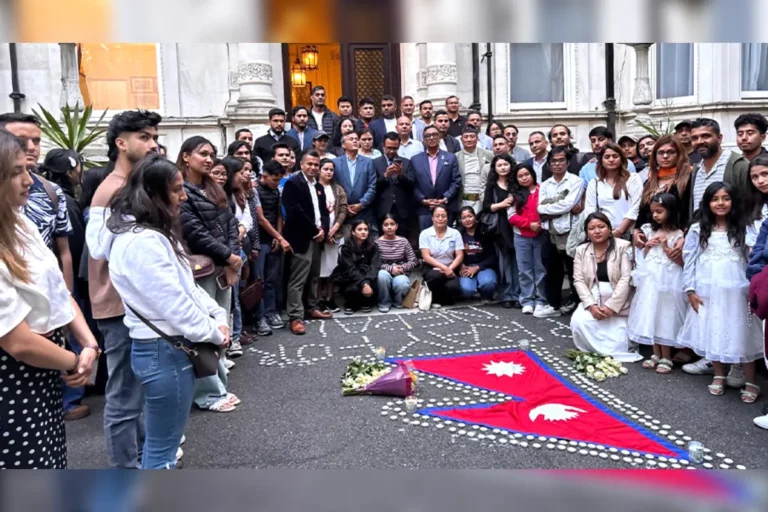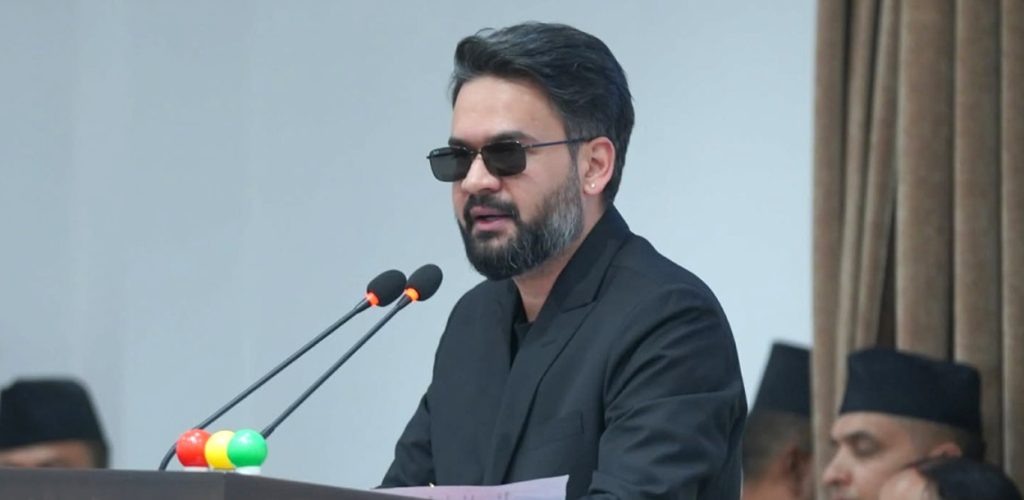
Honorable Speaker, today, I stand at the rostrum of this dignified and sovereign Parliament with a special responsibility. On Bhadra 10, a devastating flood in the Bhotekoshi River in Rasuwa snatched away, in an instant, our children who were weaving their dreams, and our parents, brothers, and sisters who were living with laughter and joy.
I offer heartfelt condolences to all those who lost their lives in this unimaginable disaster. I express my deepest sympathies to the families who are in profound grief after losing their loved ones.
I wish a speedy recovery to all the injured. I can deeply feel the pain of citizens who are still waiting, as their loved ones have not yet been found.
This pain is not just of Rasuwa, Nuwakot, or Dhading; it is a shared tragedy that has struck the heart of all Nepal. My heart chills when I hear the tragic cries of citizens caught in the flood.
However, at this moment, we do not have the luxury to rest because our bodies are tired. Even when our hearts are breaking, there is no time for mutual lamentation.
We accept the reality that in this hour of crisis, the nation’s leadership must offer courage, support, and trust to the people, not tears. Therefore, we had no other option but to fight this disaster with firm resolve and courage, and we still don’t. We are fighting.
Government Response Timeline
Following the incident, I am informing this esteemed House about what the government did for the protection of human lives, what it is doing now, and what it will do next.
Bhadra 10, 2083 BS
8:45 AM: Exactly at that time, as I was preparing to answer questions raised in this very Parliament, a notification arrived: a massive flood had occurred in the Bhotekoshi of Rasuwa. With that news, we became serious. We immediately took a briefing from the District Disaster Management Committee and instructed them to take security precautions. But a chill ran through my heart: “Did our people manage to save themselves?”
9:00 AM: Through the respective District Administration Offices, residents in the coastal areas were urged to move to safe locations.
9:15 AM: Considering the situation, we called an emergency meeting of the National Disaster Risk Reduction and Management Authority. Decisions were made on how to rescue people from the affected areas.
9:35 AM: We sent alert messages to the mobile phones of citizens in the affected areas through telecom companies.
9:45 AM: A Nepali Army helicopter took off for rescue. That was the first aerial rescue flight. We immediately kept private helicopters on standby.
10:00 AM: An emergency meeting of the Nepali Army’s Monsoon Command Post was held, and decisions were made to deploy resources for search, rescue, and relief in the affected areas.
10:30 AM: The “Search and Rescue and Emergency Response Team” was kept on standby at Tribhuvan International Airport. Security personnel from the Nepali Army, Nepal Police, and Armed Police Force, Nepal, from Kathmandu and other districts, were mobilized for search, rescue, treatment, and relief operations.
11:00 AM: A meeting of the National Disaster Risk Reduction and Management Council was held at the Office of the Prime Minister and Council of Ministers. We instructed the heads of security agencies to prioritize search, rescue, and treatment for people in crisis in the affected areas. We also directed the relevant bodies to deploy additional helicopters and drone teams.
12:30 PM: We called an emergency meeting of the Council of Ministers and decided to intensify search, rescue, and treatment in the affected areas.
Additionally, it was decided to declare 15 affected local levels as disaster-stricken areas for three months, immediately provide financial assistance to the families of the deceased as per law, promptly rescue and relocate injured and stranded individuals to safe places, and deploy Nepali Army and private sector helicopters for this purpose.
It was also decided that the Ministry of Health and Food Hygiene, the Nepali Army, and government hospitals would arrange immediate free treatment for the injured. Arrangements were made to relocate those who lost their homes to safe places and provide food and shelter. Decisions were also made to immediately restore disrupted services such as electricity supply, telecommunications, roads, and drinking water.
1:00 PM: We discussed with federal parliamentarians from the affected areas. We also gathered information via telephone from local representatives who immediately came into contact.
Honorable Speaker, we immediately initiated information collection, coordination, and monitoring through the Nepali Army’s “Joint Operation Committee,” the National Disaster Risk Reduction and Management Authority’s “Quick Action Team,” and the Prime Minister and Council of Ministers’ Office’s “Rapid Action Team.”
Along with search operations in the affected areas, the injured were rescued, brought to Kathmandu, and treatment began. We allocated 100 beds at the National Trauma Center and Bir Hospital. All other major hospitals were kept on standby.
In collaboration with the government, Nepal Scout, the World Health Organization, and the Nepal Red Cross, medical teams were deployed to the affected areas.
Coordination was initiated with the Blood Transfusion Service Center, the Health Ministries of Bagmati and Gandaki Provinces, Nepal Red Cross Society, Lions Club, and others to ensure no shortage of emergency health services, medicines, and blood.
By 3:00 PM, a team led by the Minister of Information and Communication had departed by land towards the flood-affected areas. Since then, we have continuously received briefings on the situation in the affected areas from all state mechanisms and made further necessary decisions.
We implemented decisions at all times.
7:40 PM: A public appeal was made to provide financial assistance to the Prime Minister’s Disaster Relief Fund and the Prime Minister’s Relief Fund for the affected areas. We were not only concerned with search, rescue, and treatment in the affected areas, but also had the responsibility of safely managing those who had become homeless since that day. On Wednesday, the day of the incident, eight trucks of relief materials were sent to the affected areas by midnight. By that night, voice, data, and SMS services were made free for mobile phone users in the affected areas.
Bhadra 11, 2083 BS
The next morning, I myself, along with a team including the Minister of Infrastructure Development, reached the affected areas by land to assess the situation.
The Chief Minister of Bagmati Province was also present in the affected areas with his team.
Immediately after returning from the affected areas on the same day, an emergency discussion was held with members of the Council of Ministers, and necessary decisions were made. We allocated 1.21 billion rupees for Rasuwa and Nuwakot, and 5 million rupees for Dhading.
An emergency response team was formed for the search, rescue, and consular assistance of foreign nationals. We instructed employees working in the affected districts not to leave their workplaces. We continued to make search, rescue, treatment, and relief more effective.
By 8:00 PM that day, 13,295 security personnel from the Nepali Army, Nepal Police, and Armed Police Force, Nepal, had been mobilized in the affected areas. Additionally, 351 people had been rescued through 69 flights.
During the flights, priority was given to seriously injured, pregnant women, new mothers, children, senior citizens, and people with disabilities. Preparations were made to immediately accommodate 3,500 affected individuals in schools and public community buildings in the area.
Relief materials were sent to the National Emergency Warehouse at Tribhuvan International Airport, the Nepali Army’s Maithil Barracks in Battar, Nuwakot, and the Baireni Barracks in Dhading, and arrangements were made to dispatch them to the affected areas based on priority.
A field hospital set for disaster management was sent to Trishuli. An additional 10 trucks of relief materials collected in Kathmandu were sent to the affected areas.
In the Council of Ministers meeting held on the same day, it was decided to deposit one month’s salary of the Prime Minister and ministers into the Prime Minister’s Relief and Rescue Fund.
Along with search, rescue, treatment, and relief distribution in the affected areas, efforts also began to connect damaged roads to the affected areas.
Current Situation and Government Actions
Honorable Speaker, I now ask for permission to provide this esteemed House with detailed information on the current situation and government actions.
Search and Rescue
Immediately after the incident, we intensified rescue operations in the affected areas. As of a short while ago, we have rescued 11,993 people.
However, 3,916 people are still missing. Among the 292 injured admitted to various hospitals after rescue, 182 have been discharged as of a short while ago. Our health workers are working to improve the health of the remaining injured.
Treatment and Relief
We have also deployed a team of specialists from Kathmandu to the affected areas for the treatment of citizens.
Along with treatment, we are also providing psychosocial counseling services to citizens in the affected areas.
Furthermore, we are running various campaigns to prevent any epidemic from spreading in the affected areas. Information is also being disseminated through various channels for disease prevention in the affected areas.
“Post-Disaster Communicable Disease Surveillance and Response Plan” has been effectively implemented, and necessary training has been provided to health officials at provincial and local levels.
Currently, 2,653 affected citizens have received shelter and relief in 19 temporary shelters in Nuwakot. Some affected citizens from Rasuwa are also being provided shelter and relief in Nuwakot.
Financial Aid Mobilization
The Government of Nepal is mobilizing financial assistance for flood victims through the Prime Minister’s Disaster Relief Fund and the Prime Minister’s Relief Fund, and contributions are increasing. As of a short while ago, 7 billion 8 million 57 thousand 217 rupees have been deposited in the relief fund. Just yesterday, 1 billion rupees were released from this fund to the National Disaster Risk Reduction and Management Authority. Out of that, 67.5 million rupees have been released to 15 municipalities in Rasuwa, Nuwakot, Dhading, Gorkha, and Tanahun.
As of a short while ago, this fund has a balance of 6 billion 8 million 57 thousand 217 rupees, and an additional 61 million 41 thousand 702 US dollars have been deposited.
International Goodwill and Cooperation
In this hour of disaster, we have received messages of goodwill from friendly nations through telephone, correspondence, and social media. This has given us strength to fight this calamity with even greater determination.
The international community has also extended a helping hand for the flood-affected areas. So far, friendly nations including India, Pakistan, Sri Lanka, Bangladesh, China, America, Australia, United Arab Emirates, Qatar, Switzerland, Singapore, South Korea, Japan, and the UK have provided assistance.
Similarly, international development partners, the Asian Development Bank, the World Bank, the European Union, and the United Nations have also provided assistance. Furthermore, several friendly nations and organizations have pledged their support.
Affected Infrastructure and Rehabilitation
Communication services disrupted in the affected areas began to be restored from the second day, and by yesterday, 95 percent of services have been restored.
In areas beyond communication access, communication is currently being maintained through 30 satellite phones.
The flood has caused extensive damage to operational and under-construction hydropower projects and solar projects in the Bhotekoshi-Trishuli corridor. Eight power-generating projects (281 MW) and four under-construction projects (388 MW) have been damaged. Only some of these may be repairable, and that would require significant investment. Due to the flood, 431.1 MW of electricity generation has been disrupted.
In Nuwakot, we are restoring electricity services to 85 percent of the area through alternative transmission arrangements. In Dhading, 98 percent of electricity services have been restored. In Rasuwa, 40 percent of electricity services have been restored.
Indian, Chinese, and Korean expert teams are deployed for rescue operations in the hydropower project areas.
Due to the flood, significant portions of the Galchhi-Betrawati-Rasuwa Gadhi road and the Galchhi-Mugling section of the Prithvi Highway were damaged.
Of the Galchhi-Betrawati-Rasuwa Gadhi road, the Bidur-Betrawati-Mailung-Syafrubesi-Rasuwa Gadhi section suffered complete damage over 40 kilometers and partial damage over 16 kilometers. Additionally, the Prithvi Highway was damaged in areas including Krishnabhir and Parewabir.
On the Prithvi Highway, the Galchhi, Baireni, Jarikhet, Pokhare, Munge, and Galaudi sections have been cleared of debris, and traffic has resumed.
The flood damaged 48 suspension bridges. Of these, 20 can be repaired, and 28 need to be newly constructed.
31 motorable bridges in the affected areas were swept away. The process of installing Bailey bridges at two locations has begun. On the Galchhi-Betrawati road, the Galchhi-Devighat section is being cleared of debris, and a Bailey bridge is under construction. Preparations are underway to install a Bailey bridge at Tadi Devighat. Work has also begun to install an available Bailey bridge at Betrawati, as it appears feasible. Feasibility studies are ongoing for installing Bailey bridges at 20 additional locations.
The Krishnabhir section of the damaged Mugling-Narayanghat road will be repaired and brought into operation by the end of Bhadra.
Details of damage to other infrastructure are being collected.
Body Management
Unidentified bodies are being safely managed underground after completing scientific procedures as per law.
However, DNA and other identification bases are being preserved. These bodies will be handed over to the respective families after DNA matching.
Identified bodies are being handed over to families and relatives. As of a short while ago, 1,114 bodies have been found, of which 95 have been identified and claimed by families.
Impact of Climate Change
While working tirelessly to manage the damage from this sudden and massive disaster, another profound question has arisen in our minds: How did this disaster befall us?
Experts have stated that the flood in the Bhotekoshi River in Rasuwa was the largest disaster of its kind in the Himalayan region, caused by a snow-rock avalanche in the Himalayan area.
This incident seriously indicates that the risks we face in the Himalayan region are increasing with climate change.
Therefore, we must be vigilant, and at the same time, it is time for us to strongly present before the international community the disaster we have suffered due to climate change.
Climate change is a global contribution. Its mitigation and management are the shared responsibility of the global community.
Honorable Speaker, the search for citizens missing due to the flood in the Bhotekoshi River in Rasuwa will continue. Treatment for the injured will continue.
The government will work on immediate temporary and long-term rehabilitation for those who have lost their homes. No one will be left behind.
Addressing Public Concerns
During this time, as we fought the disaster, some questions were also raised against us.
Why was there no timely flood warning?
This is one of the biggest incidents human civilization has faced. This disaster was beyond prediction. As soon as information about the approaching flood was received, our security personnel were deployed to alert local residents. At that very time, some of them also went missing.
Regarding body management.
In this major disaster, many people lost their lives in the muddy waters of the river. The flood carried their bodies to different places. We have managed only those bodies that could not be immediately identified underground, preserving DNA and other identification bases, based on legal and scientific principles. Once DNA matches, these bodies will be handed over to the respective families. They will then perform the final rites according to their religious customs. Therefore, I request everyone not to be confused about this matter.
Regarding foreign aid for rescue.
When such a huge disaster strikes, there is no question of not accepting international assistance. From the beginning, we coordinated with international countries to receive assistance as needed in the affected areas. We also tried to shorten the process to receive international cooperation.
Regarding search and rescue in power project tunnels in affected areas.
Immediately after the incident, we intensified rescue efforts wherever injured people were found and wherever helicopters could reach. Search and rescue operations are ongoing in the tunnels of the affected hydropower projects, led by the Nepali Army with a team of international experts.
Regarding coordination between federal, provincial, and local governments during the disaster.
From the outset, we were in continuous dialogue with the provincial government, as well as local governments and elected representatives. When we visited the affected areas, we held discussions with a team including the Chief Minister of Bagmati Province. Subsequently, the National Disaster Risk Reduction and Management Authority discussed with them, and it was decided that they would fulfill their respective responsibilities in disaster management even more seriously.
Honorable Speaker, we express our gratitude to all security personnel, civil servants, members of the Council of Ministers, provincial and local governments, political parties, elected representatives, local communities, volunteer organizations, general citizens, friendly nations, international organizations, and all stakeholders who have been engaged from the search, rescue, treatment, relief, and management phases to the rehabilitation phase after the disaster. We request their continued support and cooperation in the days to come.
The government was with you yesterday, is with you today, and will be with you tomorrow.
Thank you.