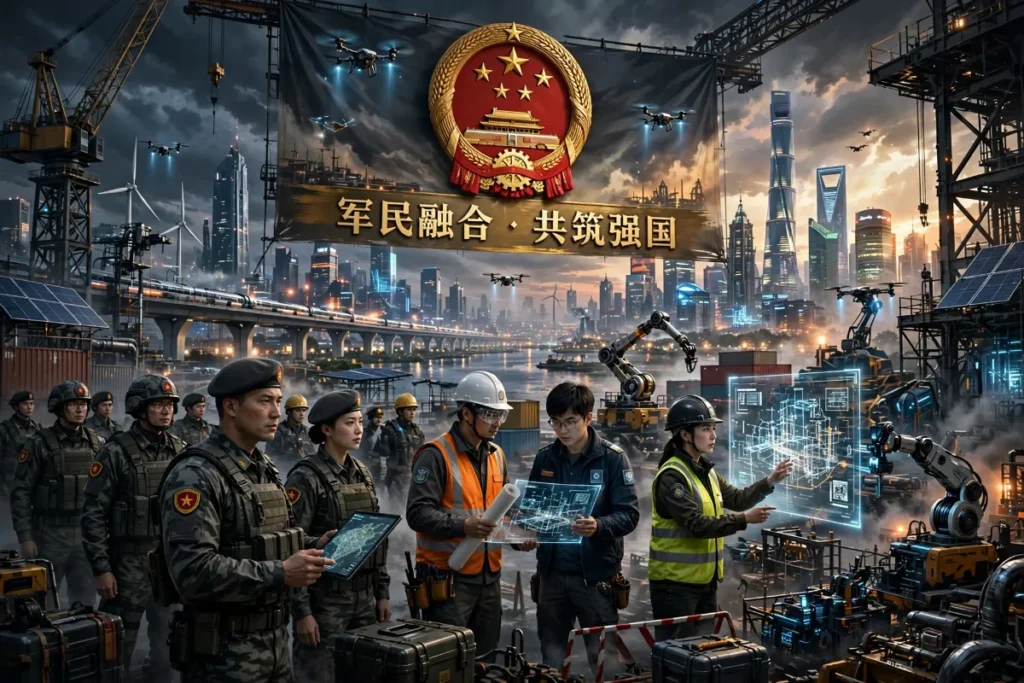
China has significantly amended its national defense mobilization law, allowing the government to utilize civilians, private companies, and other national resources during times of war or major crisis, rather than solely relying on the military. The revised law, approved by China’s National People’s Congress on August 28, is set to take effect on October 1.
The new legislation not only permits the requisition of resources but also places them under government control. It includes provisions for penalties and fines for those who refuse to comply with orders or intentionally delay their implementation.
Major Changes After 16 Years
The National Defense Mobilization Law was originally enacted in 2010. This marks the first significant revision to the law since its inception. The updated legislation comprises 14 chapters and 82 articles.
According to China, the primary objective of these changes is to enable the country to rapidly transition from a state of peace to a state of war during any perceived threat. This includes the ability to harness economic and social power for defense purposes.
The new law also incorporates the protection of “development interests” alongside the defense of national sovereignty, unity, territorial integrity, and security.
Party-Led Mechanism for Military-Civilian Resource Mobilization
According to Samantha Hoffman, an expert at the Jamestown Foundation, the new law introduces changes in areas such as party leadership, organization, reserve forces, recruitment, storage of essential materials, and defense-related education.
Articles 3 and 17 of the law place the national defense mobilization system under the direct authority of the Central Committee of the Communist Party of China. Previously, the State Council and the Central Military Commission held primary roles in this regard.
Hoffman explains that, when necessary, the Party will be able to simultaneously mobilize military, civilian, economic, and social resources to achieve its strategic objectives.
Hospitals, Internet, and Transportation Must Be Ready
Under the new law, sectors such as transportation, postal services, telecommunications, cybersecurity, medical and pharmaceutical supply, food and grain supply, and engineering will be required to be prepared for national defense responsibilities.
Units within these sectors must establish special teams and provide them with training to ensure they can act immediately when needed.
Cybersecurity has been specifically included, and the law also mentions enhancing defense capabilities through the use of new and advanced technologies.
Provisions have also been made for establishing reserve forces, strengthening the recruitment system, and increasing the storage of strategically essential materials.
Development Now a National Security Issue in China
The 2010 law stipulated that defense arrangements would be activated if China’s sovereignty, unity, territorial integrity, and security were threatened. The revised law now includes “development interests” in this scope.
This means that threats to China will no longer be limited to its borders or national security alone. Interests related to the economy, access to essential resources, Chinese assets abroad, and technological development can now also be considered part of national security.
Samantha Hoffman of the Jamestown Foundation notes that this change is also linked to China’s National Defense Law, which was amended in 2020. That law also included provisions for initiating defense mobilization if the country’s development interests were threatened.
Is China Preparing for War?
Following the new law, questions are arising about whether China is genuinely preparing for war. Experts hold differing opinions on this matter.
Theresa Fallon, director of the Centre for Russia Europe Asia Studies in Brussels, has expressed concern regarding the new law. On X (formerly Twitter), she stated that the risk of war globally is increasing and is difficult to ignore.
She questioned whether situations like the depletion of US military reserves, the Russia-Ukraine war, and the Israel-US conflict linked to Iran are compelling Chinese President Xi Jinping to believe that the time for war is approaching.
Conversely, Lyle Morris of the Asia Society Policy Institute holds a different view. According to him, this law should not be seen as China’s sudden preparation for war. He suggests that China has been making such preparations for over a decade.
Nevertheless, the new law indicates that China is not only preparing its military for a major crisis but is also making civilians, companies, essential services, technology, and data part of this readiness. Experts suggest that Taiwan and the United States could be China’s potential major military adversaries in the future.