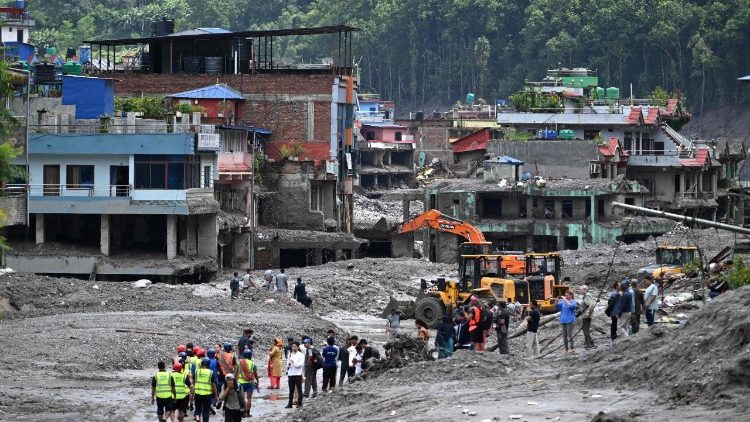
The Government of Nepal has been actively and resolutely engaged in search, rescue, treatment, relief, and safe management of citizens since the Bhote Koshi River in Rasuwa flooded six days ago. The Prime Minister expresses heartfelt gratitude to all security personnel, civil servants, media, officials from various agencies, volunteer organizations, and the general public who have been at the forefront of this effort, risking their lives.
The patience, support, cooperation, and coordination demonstrated during this period are commendable and praiseworthy. The assistance from provincial and local governments to the federal government in disaster management has been crucial. Similarly, the goodwill and cooperation shown by friendly nations, domestic and international organizations, and media outlets are exemplary.
Relief Management
The government is currently focused on search and rescue operations in the affected areas. Simultaneously, the collection and distribution of relief materials for citizens in these areas remain a government priority. Relief supplies received from organizations and the general public in Kathmandu and other parts of the country are being collected and delivered to affected citizens. The international community is also assisting in this effort.
To date, assistance has been received from friendly nations including India, China, the USA, UAE, Qatar, Japan, Switzerland, and Australia.
Our security personnel have delivered relief to 3,696 affected citizens in Rasuwa and Nuwakot districts through 27 distribution centers, via four collection centers in the affected areas (Rasuwa, Nuwakot, and Dhading) using air and road routes. Provincial and local governments are also actively involved in providing shelter and managing relief at these centers, in coordination with the federal government. The National Disaster Risk Reduction and Management Authority continuously provides updates on relief collection and distribution. To ensure the effectiveness of relief collection and distribution, members of our secretariat and staff have also been deployed to the affected areas.
Financial Assistance
The Government of Nepal is mobilizing financial assistance for the victims through the Prime Minister’s Disaster Relief Fund and the Prime Minister’s Fund, with contributions steadily increasing. The Office of the Prime Minister and Council of Ministers has launched an ‘Aid Request Portal’ to transparently publicize details of funds received from both domestic and international sources for these funds.
As of midday today, a total of NPR 5,87,92,23,842 has been deposited into the accounts of nine commercial banks under the Prime Minister’s Relief Fund. Additionally, USD 3,193,238 has been deposited into Himalayan Bank and Laxmi Bank. Several countries and organizations have also pledged financial support.
Road Network
The area across the Trishuli River in Nuwakot, which was affected by the floods, has been reconnected to the road network. The road from Galchhi–Trishuli Highway, along the right bank of the Trishuli River, passing through Kalleritar, Koshikhola, Piplatar, Darshantar, Chhatrekhola, and Gauribensi to Trishuli Bazaar, has been reopened. This has re-established direct road access for a large number of citizens in Nuwakot to the district headquarters.
This restoration will further facilitate rescue operations, distribution of relief materials, and supply of essential goods to the affected areas. Most bridges in Rasuwa, Nuwakot, and Dhading have been damaged, impacting transportation. The government has prioritized the construction of temporary bridges in these areas. We have six Bailey bridges of 48 meters length and one of 70 meters length. Studies have been completed for installing Bailey bridges at three locations: Tadi River at Devighat, Trishuli Bazaar, and Betrawati Bazaar.
Furthermore, the Government of India has provided a 230-foot single-lane modular steel bridge and has pledged to send seven more Bailey bridges. The Government of China is also expected to provide 30 Bailey bridges soon.
Rescue and Treatment
We intensified rescue operations in the flood-affected areas. A short while ago, 11,379 people had been rescued, while 3,925 remain out of contact. The number of missing persons is fluctuating. Of the 279 injured citizens rescued from the affected areas and admitted to various hospitals, 168 have been discharged as of recently.
Continuous Briefing
We are regularly receiving updates from security agencies regarding the ongoing work and current situation in the flood-affected areas. Today, we received a detailed briefing from the chiefs of the Nepali Army, Nepal Police, and Armed Police Force, Nepal, concerning search, rescue, treatment, relief, and rehabilitation. They provided information on the search, rescue, relief, and management efforts undertaken so far.
We are also continuously receiving information from members of the Council of Ministers, federal parliamentarians, and other colleagues deployed in the affected areas. This process will continue without interruption.
Electricity and Communication Services
The restoration of electricity in the affected areas is ongoing. Approximately 30 percent of households in Kalikasthan, parts of Naukunda, parts of Ward 5 and 6 of Gosaikunda Rural Municipality, and the district headquarters Dhunche in Rasuwa district have had electricity restored. Additionally, preparations are underway to operate electricity through a separate system from the Sanjen Hydropower Project in some parts of Amachhoding Rural Municipality. For electricity services in the remaining parts of the district, 500 portable solar units have been dispatched for household use.
In Nuwakot district, where electricity services were affected throughout, 85 percent of the area has now seen power restored. Work is underway to provide electricity services to the remaining 15 percent within the next five days. Electricity is being restored in parts of Wards 1, 3, 5, 6, 10, and 11 of Bidur Municipality; parts of Wards 1, 2, 3, 4, 5, and 6 of Tarkeshwar Rural Municipality; Wards 7 and 8 of Belkotgadhi Municipality; and throughout Kispang Rural Municipality.
Similarly, in Dhading, where the area along the Prithvi Highway (Gajuri, Adamghat, Malekhu, Jahare, up to Mauwakhola) was affected, electricity services have been restored in the entire district (98 percent) except for some parts of Adamghat. Work is ongoing to restore electricity services in all areas within the next two days.
Communication services have also been restored in most locations. Out of 120 Nepal Telecom BTS towers, 110 have resumed service, and 75 out of 78 Ncell towers have started providing services.
Rescue from Affected Hydropower Projects
Various hydropower projects have been affected by the floods. It is suspected that some personnel working on these projects are out of contact. The Nepali Army has so far rescued 279 individuals from various hydropower projects. Search and rescue operations are also continuing inside the project tunnels.
A Nepali Army team rescued two individuals from the Rasuwagadhi Hydropower Project. A joint team of Chinese and Nepali forces searched inside the tunnel of this project. The rescue team returned after not finding anyone inside the tunnel.
In Rasuwa, for the Langtang Khola and Chilime Hydropower Projects, the Nepali Army, along with an Indian rescue team and some Nepali assistants, have been working since this morning to clear the tunnel entrances. The Nepali Army has rescued nine individuals from the Mailung Khola Hydropower Project. A total of 254 individuals have been rescued from the Upper Trishuli-1 Hydropower Project. Search and rescue efforts are underway in the tunnel of this project, with Nepali, Korean, and Chinese teams working alongside the Nepali Army.
In Nuwakot, a 90-member team comprising personnel from the Nepali Army, Armed Police Force, and Nepal Police is attempting search and rescue in the tunnel of Upper Trishuli-3A. A team from the Nepal Electricity Authority is also assisting at this location. The Nepali Army has rescued two individuals from the Upper Trishuli-3B Hydropower Project area. Currently, an additional nine Nepali Army personnel have been deployed to this project, bringing the total to 31 individuals engaged in search and rescue. The Nepali Army began search and rescue efforts here after a reconnaissance by a Chinese rescue team.
Three individuals have been rescued from the Trishuli Hydropower Project in Nuwakot, four from the Solar Project, and four from the Devighat Hydropower Project.
Body Management
The bodies of those who lost their lives in the floods and those who cannot be identified are being managed according to legal and scientific procedures. This is being done in accordance with the ‘Management of Unidentified and Unclaimed Bodies (First Amendment) Directive, 2083’. In cases where bodies are found in an unidentifiable state, the government is managing them itself while preserving DNA and other bases that aid identification. So far, 939 bodies have been recovered. These bodies are being managed with the assistance of the Nepali Army, Nepal Police, and Armed Police Force, Nepal. Identified bodies are being handed over to their relatives.
Major Disaster in the Himalayan Region
The flood in Rasuwa’s Bhote Koshi River was not an ordinary flood. It is a major disaster in the Himalayan region, caused by a snow-rock avalanche in the Himalayas. This event indicates that the risks we face due to climate change are increasing in the Himalayan region. Therefore, this region must be vigilant, and it is also time for us to strongly raise the issue of disasters experienced due to climate change with the international community.
On Rehabilitation
Alongside search and rescue operations in the affected areas, the government has initiated discussions on how to rehabilitate affected citizens. For this purpose, details of the number of affected citizens and physical damage are being collected in coordination with local governments. Thousands of citizens have lost their homes, families, loved ones, and property. The government understands their pain. The path forward is to alleviate their suffering and restore them to normal life through rehabilitation. The government will work to empower them mentally and physically through rehabilitation. Efforts to secure the necessary financial resources for rehabilitation are ongoing.